The Immigrant Daughter’s Burden: Caring, Guilt, and the Journey Back to Yourself
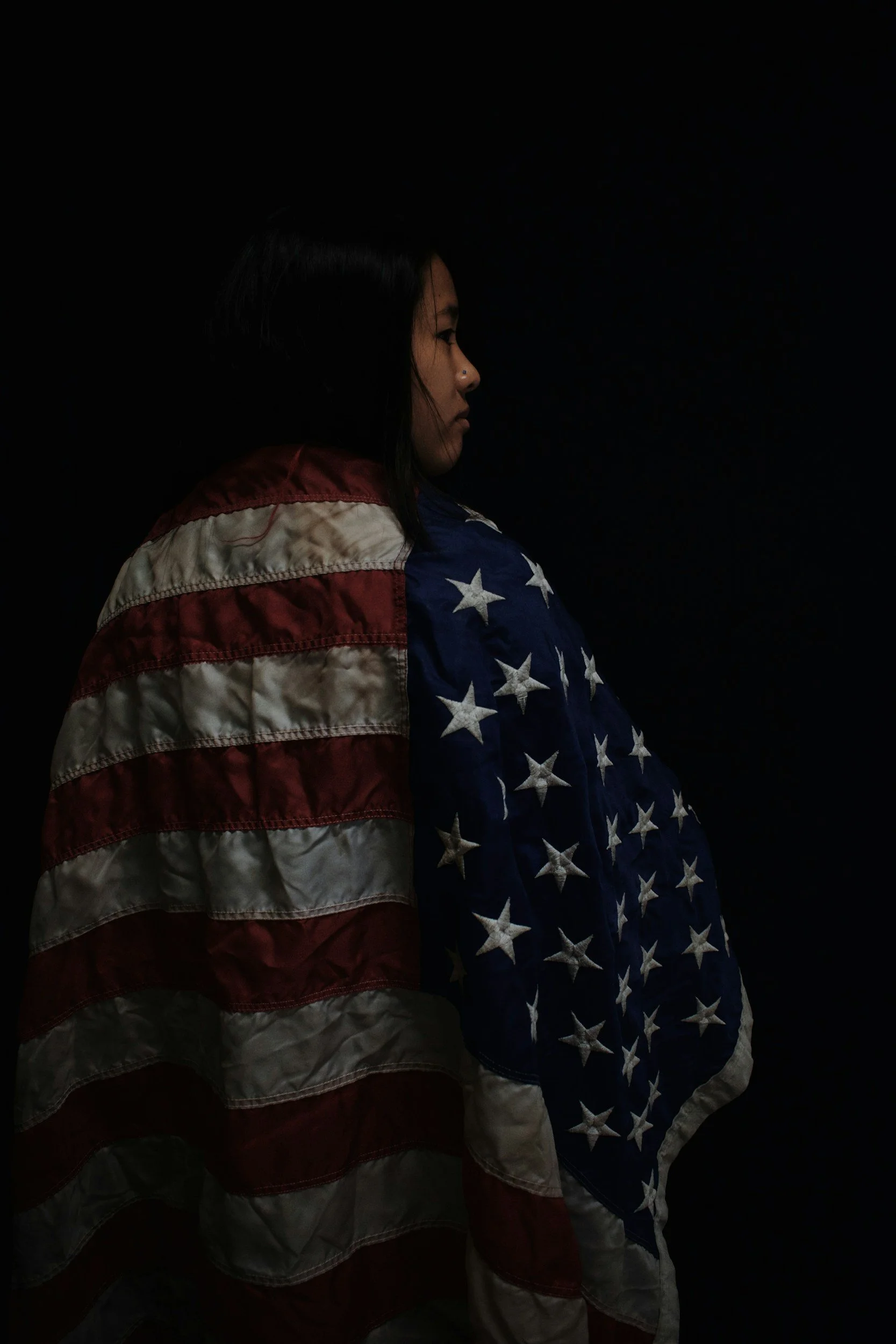
woman wearing a distressed American flag around their back in the foreground. background is dark.
The Immigrant Daughter’s Burden: Caring, Guilt, and the Journey Back to Yourself
There is a specific kind of heaviness many immigrant daughters know well. It is not always spoken, but it is felt deeply in the chest, in the nervous system, and in the quiet moments when we realize we grew up carrying more than what belonged to us.
For many of us, responsibility was not something we slowly stepped into. It was something placed on our shoulders early in life. We became the strong one, the mature one, the one who helps, the one who sacrifices, the one who stays silent to protect the peace. We learned early that our family stability often depended on our emotional labor and our ability to stay composed.
This is not simply a personality trait; it is cultural.
In many Latinx, Caribbean, African, and other collectivist families, daughters are expected to hold the emotional center of the home. These expectations come from values such as familismo, loyalty, gratitude, and resilience. They grow out of survival and love, yet they can shape our identity in ways that feel both meaningful and heavy.
One common experience is parentification. This is when a child steps into emotional roles that belong to adults. You may have been the translator at appointments, the one who mediated conflict, the emotional support for a parent, or the daughter who felt she could not create more stress. These roles were not chosen. They were inherited.
And because they were inherited, they often become tangled with guilt.
Immigrant daughters carry guilt in very particular ways. It may show up when we rest. When we say no. When we want independence. When we choose a different path. When we prioritize our mental health. Sometimes guilt becomes the filter through which we evaluate our decisions.
But guilt is not always proof that we are doing something wrong. Sometimes it is evidence that we are doing something new.
Many daughters grow up in survival mode. This is a state where the nervous system is always bracing for pressure, responsibility, or emotional demand. In this place, we learn to quiet our own needs and anticipate the needs of everyone else. It becomes familiar. It becomes normal.
Therapy helps us understand that the body does not want to live in survival forever. The body seeks safety. It seeks the ability to rest, to breathe, to feel, and to exist without constant vigilance.
Shifting from survival to safety takes time. It means unlearning the belief that our worth is measured by how much we give. It means grieving the childhood parts of ourselves that had to grow up too quickly. And it invites us to consider a question that may feel unfamiliar or even rebellious.
What would it look like to choose myself, not instead of my family, but alongside them.
Healing does not require abandoning culture or distancing yourself from where you come from. Healing is understanding that love does not require self loss. It is the process of honoring your story without repeating the patterns that kept previous generations from their own peace.
Immigrant daughters often need help understanding why life can feel so heavy.
Parentification teaches us to carry everything.
Attachment patterns make us fear disappointing the people we love.
Intergenerational trauma keeps us alert and cautious.
Cultural narratives praise sacrifice before rest.
Emotional bilingualism forces us to translate feelings and experiences that are not ours.
Gender expectations place emotional labor on daughters far more than on sons.
When we begin to see these patterns clearly, something inside us softens. This makes sense. I make sense.
Healing begins with gentle change. Naming what you feel. Allowing yourself to rest without earning it. Setting small boundaries that protect your energy. Releasing the myth of the perfect daughter. Practicing self compassion. Reclaiming parts of yourself that you set aside to keep the peace.
None of this makes you selfish. It makes you human.
And being human does not make you less of a daughter. It allows you to become a daughter who exists as a whole person, not only as a role.
You are not ungrateful. You are not abandoning your family. You are not dramatic or difficult.
You are breaking cycles with courage and grace. You are choosing a life where your wellbeing matters. This choice becomes a gift to you and to the generations who will come after you.
About the Author: Selenny Liranzo, MHC LP, is a bilingual Mental Health Counselor specializing in trauma, anxiety, cultural identity, immigrant family dynamics, and life transitions. She offers therapeutic support in English and Spanish and helps clients move from survival mode into a grounded and compassionate relationship with themselves.